
 Browse Our Wide Selection of Beds, Chairs & More


By Yeti Beds Team · Updated October 29, 2026
Do you need a box spring? Usually, no. A platform bed or any slatted frame supports a mattress on its own, and foam mattresses are not designed for box springs. You still need firm, even support. A box spring or foundation mainly matters under an innerspring mattress built to pair with one, or on a bare metal rail frame.
Every bed used as an example below lists wood slats and no box spring required, so for our platform beds the sharper question is whether the slat gap is within your mattress maker's limit.
| Base | Box spring | Foundation | Bunkie board | Slatted platform bed | Adjustable base |
|---|---|---|---|---|---|
| What it is | Box of metal springs in fabric | Rigid base of solid wood or spaced slats | Flat panel, 1 to 3 inches thick | Base on legs; needs no frame or box spring | Varies by model |
| Adds height | About 9 inches, or 5 to 5.5 inches low-profile | Yes; varies by model | A few inches | No extra layer | Varies by model |
| Has give | Yes, some bounce and give | No, rigid | No, rigid | Varies by model | Varies by model |
| Works best with | Innerspring built for one | All mattress types | Slatted frames, daybeds, trundles, loft beds | Any type, if the maker allows the gap | Ask the mattress maker |
| Skip it if | You own an all-foam mattress (or one of many latex and hybrid models), or an adjustable base | Your slats already support the mattress | Your maker rules bunkie boards out | Your innerspring was built for a box spring | You plan to use a box spring |
What is a box spring, and what does it do?
A box spring is a wooden or metal box of metal springs, wrapped in thin fabric, that sits between mattress and frame. It absorbs some movement, lets air move under the mattress, and raises the bed.
Heights differ: a standard high-profile box spring is 9 inches tall, while low-profile versions run 5 to 5.5 inches.
That give suits most innerspring mattresses but not foam. Serta's downsides: box springs are heavy, can get squeaky over time, and are not meant for memory foam. Sleep Foundation adds that they often need replacing every 10 years.
Do you need a box spring with a platform bed?
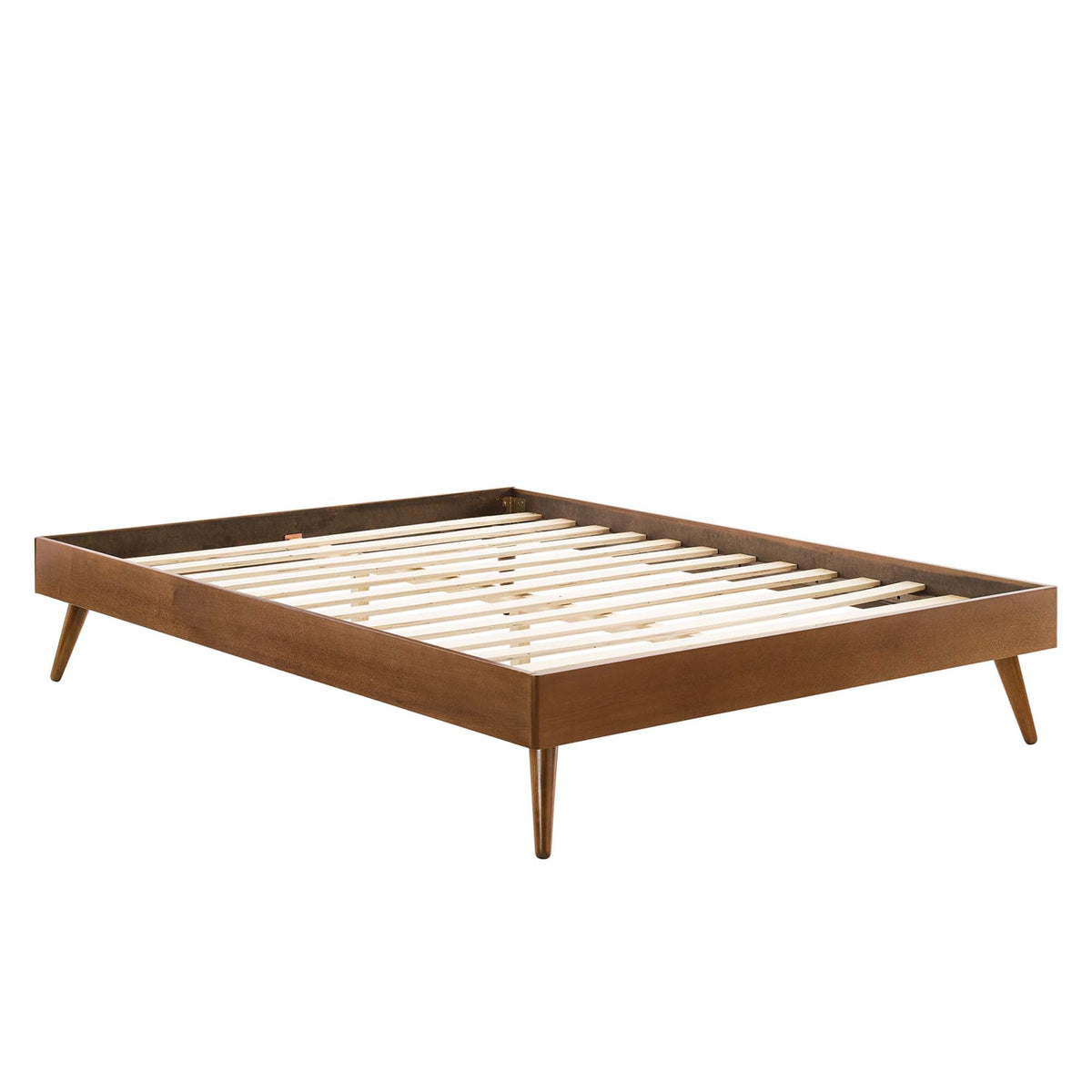
No. A platform bed is a thin slatted or solid base on four or more legs that holds the mattress without a separate frame or box spring; The Strategist says with any slatted frame you almost certainly do not need one.
The Margo queen platform bed has wood slats 3.5 inches apart over a reinforced center beam with supporting legs, a 601-pound listed weight capacity; the listing calls it a foundation for memory foam, latex, innerspring and hybrid mattresses.
The Lucera full bobbin bed lists slats 3.2 inches apart, 12.3 inches from floor to slat top, a recommended 10-inch mattress and a 26.9-inch footboard. That puts the mattress top at roughly 22.3 inches, about 4.6 inches below the footboard. A 9-inch box spring on those slats would push the mattress top to roughly 31.3 inches, above the footboard.
The Lucera twin bed lists slats 3.1 inches apart and 11.9 inches to slat top, so a 10-inch mattress tops out at roughly 21.9 inches. The Ginny full platform bed and its twin version pair a solid wood frame and cushioned headboard and footboard with wood slats, no box spring needed. None of these listings includes a mattress, and all require assembly.
Which mattresses need a box spring?
Innerspring mattresses are often designed for one. Memory foam and other all-foam mattresses are not, nor are many latex and hybrid mattresses. If unsure, Sleep Foundation says to check the warranty or contact the manufacturer.
- Innerspring: often built to pair with a box spring and sold with one.
- Memory foam and all-foam: needs rigid support and can be damaged or wear out faster on a box spring.
- Latex and hybrid: many are not built for one either; Casper says modern foam and hybrid designs work on solid or slatted frames and platform beds.
Pocketed coils overtook interlocking coils only in the past decade or so, and John Schindler of Garner Appliance & Mattress told The Strategist that a pocketed-coil mattress on an equally flexible base can "over-conform" and lose support over time.
How far apart should bed slats be?
It depends on who made your mattress. Happsy's warranty says no more than 3 inches, Avocado recommends 3 inches or less, and Stearns & Foster allows 4 inches with extra rules on slat width and center support.
| Mattress brand rule | Max slat gap | Other requirements |
|---|---|---|
| Avocado | 3 inches recommended; 5 inches for warranty | Box springs not recommended; their flex can reduce support and, per Avocado, may void its warranty |
| Happsy | 3 inches | Solid platform, bunkie board or unyielding slats; wider gaps "will void your warranty" (Happsy's words, about Happsy mattresses) |
| Stearns & Foster | 4 inches | Queen and king: rigid center bridge bar with at least 5 legs, or 5 equally spaced hardwood cross-slats at least 3 inches wide with a center leg; plywood, bunkie boards and plastic liners listed as inadequate |
The listed gaps on our beds: Lucera twin 3.1 inches, Lucera full 3.2 inches, Margo queen 3.5 inches with a reinforced center beam and supporting legs. All three are inside Stearns & Foster's 4-inch gap and Avocado's 5-inch warranty gap, but wider than Happsy's 3-inch limit and Avocado's 3-inch recommendation. Slat width and count are not listed, so ask your maker if it sets those too.
Our view: if your maker's limit is 3 inches, add a rigid bunkie board or foundation on the slats, unless your maker rules bunkie boards out, as Stearns & Foster does; then ask the maker. And before buying any box spring, measure the gap between two slats with a tape measure.
Box spring vs foundation vs bunkie board: what's the difference?
A box spring flexes, a foundation is rigid, and a bunkie board is a thin rigid panel you add on top of something else.
A foundation is a wooden or metal base wrapped in fabric and fitted with wooden slats, which Tom's Guide calls "similar to a box spring, but slatted instead of sprung." Serta says foundations work with all mattress types, prevent sagging and raise the bed.
A bunkie board is a flat piece of particleboard or plywood that Saatva puts at 1 to 3 inches thick and Avocado at 1 to 2 inches. Invented for bunk beds in the early 20th century, it gives thinner support than a box spring and more uniform support than slats. Saatva suggests one over a slatted platform frame, an older box spring, a loft bed, a daybed or a trundle bed (see what a trundle bed is). Two cautions: on slats it reduces airflow, so you may sleep warmer, and Avocado says it should never go directly on the floor.
Why don't people use box springs anymore?
Frames and mattresses both changed. Over the past 20 years platform and slatted beds became the norm in the US, and modern non-innerspring mattresses absorb the shock a box spring used to handle.
Older steel bed rails needed a box spring because they could not hold a mattress alone. On the mattress side, Casper says modern non-innerspring mattresses use materials that absorb the shock box springs once handled.
Can you put a mattress directly on a bed frame or the floor?
On a frame with slats or a solid platform, yes. On bare metal rails, no, because rails alone cannot hold a mattress. The floor comes with trade-offs.
Serta's floor caveats: check your warranty, since some require a proper bed base, and expect no shock absorption or airflow, so you may sleep hotter. Sleep Foundation says nearly all mattresses work best with support beneath them rather than on the floor. Swapping old rails for a slatted frame like the Margo or Lucera above removes the need; see our wood platform beds.
When do you still need a box spring?
You still need one when your innerspring mattress was built to pair with it, or when your frame cannot support a mattress on its own. Extra height is a want, not a need.
- An innerspring designed to be used with one, often sold as a pair.
- Old steel rails or another frame that cannot hold a mattress on its own.
- Height, if you want it: some people find a higher bed easier to get in and out of, though The Strategist says you only truly need one if the frame cannot support the mattress.
Who should not add one: foam mattress owners, and many hybrid and latex owners, on a slatted platform bed. These mattresses are designed to work on slatted frames, and a box spring can change its feel. Never on an adjustable base; they are incompatible.
Our recommendation: buy a slatted platform bed, check its listed slat gap against your mattress maker's limit, add a bunkie board only if the gap is wider, and skip the box spring unless you own an innerspring built for one. Start with the listed slat gaps in our platform bed frames collection.
Frequently asked questions
Do memory foam mattresses need a box spring?
No. Sleep Foundation says it is better not to use a box spring under memory foam unless the manufacturer specifically recommends it, since the wrong base may void the mattress warranty. A slatted platform bed, foundation or bunkie board works instead.
Can you put a box spring on a platform bed?
Yes, though in our view it mostly adds height and weight. On the Lucera full, a 9-inch box spring plus the recommended 10-inch mattress would put the mattress top at roughly 31.3 inches, above the 26.9-inch footboard. For height, a low-profile box spring or bunkie board is the smaller step.
What can I use instead of a box spring?
A foundation, a platform bed with slats or a solid deck, a bunkie board on top of slats, or an adjustable base. Sleep Foundation lists foundations, platform beds and adjustable frames as alternatives. Check your mattress maker's slat rule before relying on slats alone.
Do I need a box spring with a metal bed frame?
It depends on the frame. Bare metal rails with nothing across them cannot hold a mattress on their own, so they need a box spring or foundation. A metal platform frame with slats supports the mattress directly, so treat it like any slatted bed and check the gap.