
 Browse Our Wide Selection of Beds, Chairs & More


By Yeti Beds Team, updated November 2026
A daybed is a three-sided bed frame (a back panel plus two side arms) that works as a sofa by day and a bed at night. It holds a standard mattress, usually a 38 x 75 inch twin, with full and queen versions. Unlike a futon or sofa bed, its main mattress stays in one position (The Spruce, citing designer Allison Garrison).
Below, we compare a day bed with a sofa, a futon and a sofa bed, then show the listed sizes of three frames from our daybeds range. If the guest is tall, or two adults will share it, start with our queen size daybeds.
What is a daybed?
A daybed is a bed frame with a back and two arms that holds a standard mattress and doubles as seating. Merriam-Webster defines it as "a couch that can be converted into a bed," and lists an older sense: a type of chaise longue made between 1680 and 1780. It dates the word's first known use to 1679.
Better Homes & Gardens describes a frame on three sides: a headboard, a footboard and a backboard that runs the entire length of the bed, where a regular bed has only a headboard and footboard. It names offices, guest rooms, basements, patios and kids' rooms as good spots.
How is a daybed different from a sofa, a futon and a sofa bed?
A daybed is a bed you can sit on, and a sofa is seating only. The Spruce, citing designer Allison Garrison, says a futon's mattress is exposed and can be set up as a sofa or a bed, while a sofa bed's mattress is hidden and reached by removing the seat cushions.
Daybed vs. sofa vs. futon vs. sofa bed
| Daybed | Sofa | Futon | Sofa bed | |
|---|---|---|---|---|
| What it is | A three-sided frame used as a bed or a couch | Furniture for "wakeful lounging" | A usually cotton-filled mattress used on the floor or in a frame as a bed, couch or chair | Looks like a couch, with a folded spring bed that pulls out from under the seat cushions |
| The mattress | A standard mattress, always in one position | None | Exposed; moves between sofa and bed; twin, full or queen sizes | Hidden and folded; reached by removing the seat cushions |
| Making the bed | No pull-out mechanism for the main mattress | Not a bed | Set the mattress in its bed position | Pull it out; measure how far it extends |
| Best for | Sleeping often | Everyday seating | Switching between sofa and bed | Seating first, with occasional overnight use |
| Watch-outs | Needs a wall or corner; size limits | Not made for sleeping | Cushion "will flatten over time" (Janna Robinson) | A thinner sleeper sofa mattress, meant for occasional use |
| Sources | BHG, The Spruce (daybeds), The Spruce (futons) | BHG | Merriam-Webster, The Spruce (futons) | BHG, The Spruce (daybeds), The Spruce (futons) |
On daybed vs sofa, BHG says beds are for sleeping, sofas for wakeful lounging, and daybeds serve both. The Spruce calls a daybed ideal when it will be used for sleeping often, since daybeds use real mattresses, and a sleeper sofa ideal when seating comes first. For styling, see our ideas for using a daybed as a sofa.
The daybed vs futon question starts with which futon you mean. The Spruce separates the traditional Japanese futon, a frameless cushion on the floor, from the sofa-like Western futon, which generally sits on a wood or metal futon frame. Wikipedia describes the Japanese shikibuton mattress as usually 2 to 3 inches thick, folded and stored away during the day.
What size mattress does a daybed take?
Most daybeds take a twin mattress, which measures 38 x 75 inches, though full and queen daybeds exist. BHG says most can accommodate a 38" by 75" twin, and The Spruce notes some hold a full, 54 inches wide by 75 inches long. Daybeds use real mattresses, so you buy a standard one in the frame's size.
The Sleep Foundation lists a twin at 38" x 75", a twin XL at 38" x 80", a full at 54" x 75" and a queen at 60" x 80". Is a daybed a twin or a twin XL? Most take a twin; the frame's listed mattress space settles it.
What three real daybeds measure
| Daybed | Mattress space (as listed) | Overall frame W x D x H (as listed) | Trundle (as listed) |
|---|---|---|---|
| Midori walnut twin daybed | 39" W x 74" D | 79.1" W x 41.1" D x 41.9" H | None |
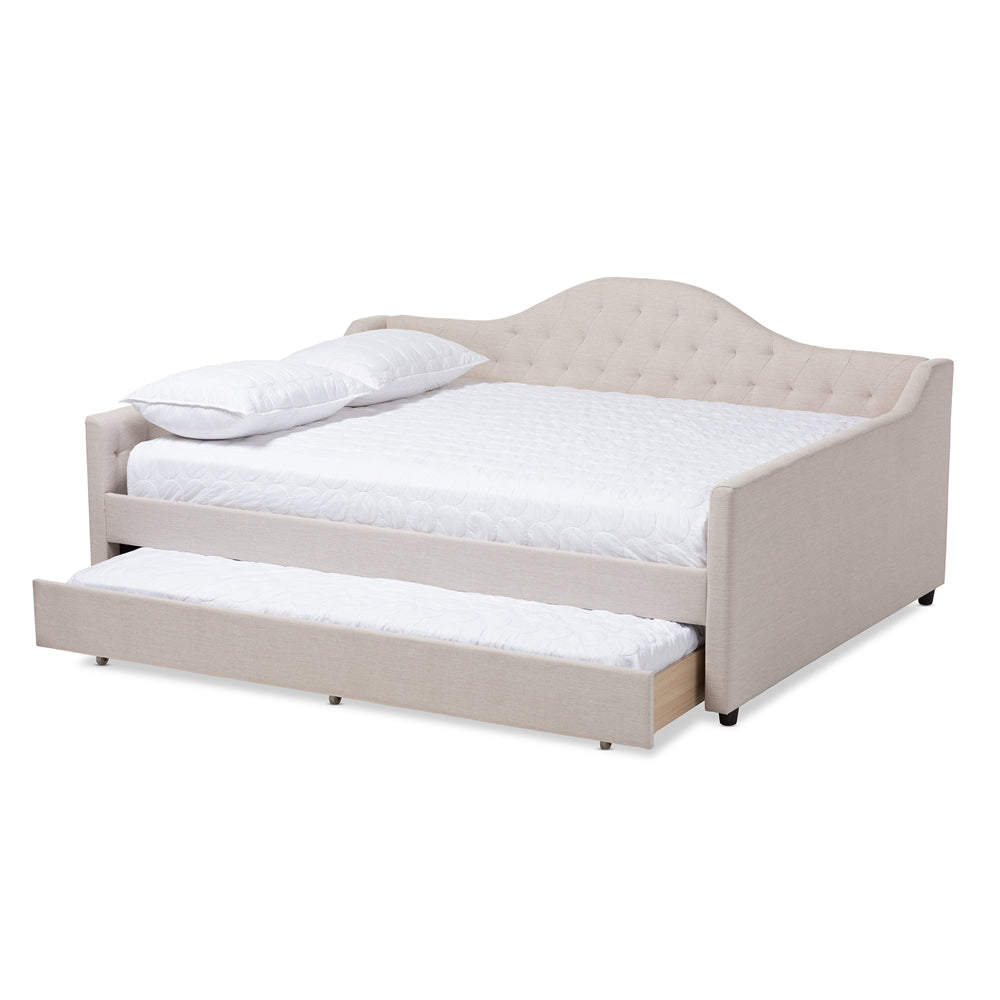
| Eliza queen daybed | 60" W x 80" D | 86.22" W x 63.78" D x 31.3" H | Pull-out twin trundle, 79.53" W x 40.35" D x 7.87" H |
| Jona navy velvet queen daybed | 60" W x 80" D | 85" W x 62.2" D x 33.3" H | Roll-out twin trundle, 76" W x 41.3" D x 9.4" H |
The Midori listing gives 39" W x 74" D, which differs from the 38 x 75 twin standard, so compare your mattress with each frame's listed inside dimensions. Overall dimensions matter too: by our maths, the footprint grows from about 22.6 sq ft for the Midori to about 38 sq ft for the Eliza.
What types of daybeds are there?
The main types are trundle, storage, simple open-frame, upholstered, and wood or metal daybeds. BHG also lists outdoor daybeds.
- Trundle daybed: BHG describes a pop-up trundle that adjusts to the daybed's height and a drawer trundle that stays on the floor. The Eliza listing gives a pull-out twin-size trundle; the Jona listing gives a roll-out twin-size trundle. Browse daybeds with a trundle or read how trundle beds work.
- Storage daybed: drawers or shelving (BHG).
- Simple or open daybed: empty space under the frame (BHG).
- Upholstered daybed: often with button tufting or nailhead trim (BHG). The Jona listing gives navy blue velvet with foam padding; the Eliza listing gives button-tufted light beige fabric.
- Wood daybed: BHG describes solid wood frames. The Midori listing gives solid rubberwood and MDF (so not solid wood throughout), a walnut brown finish and tapered, slatted panels.
- Metal daybed: The Spruce lists wood, metal, wicker and upholstery as frame materials.
Can adults sleep on a daybed?
Adults can sleep on a daybed: The Spruce says daybeds can be used daily as a regular bed, and that a quality mattress is essential if used regularly. For anyone over 6 feet tall, the Sleep Foundation suggests a bed with at least 80 inches of length, which is why we point tall adults to a queen daybed.
The Sleep Foundation says twin and twin XL are only for single people. The Spruce says a twin daybed without a trundle is too narrow for two adults, a full is more feasible, and a trundle provides two sleeping areas. The Eliza and Jona listings both give a 60" W x 80" D mattress space, a standard queen.
In our view, choose the best daybed for adults by who sleeps on it, not by how it looks as a sofa: for a guest over 6 ft or two adults, a queen is the better fit than a twin.
What are the downsides of a daybed?
The main downsides of a daybed are size limits and a fixed spot against a wall. BHG says that unless you choose a pop-up trundle, the bed is likely no bigger than a twin, and that daybeds need a wall or corner because they typically have a high back. Queen daybeds do exist (the Eliza and Jona listings give a 60" x 80" mattress space), so the limit depends on the model.
The Spruce lists three cons: "Small in size," "Some mattresses not supportive" and "Restricted location."
In our view, a queen daybed's 62.2 to 63.78 inch depth (per the Jona and Eliza listings) makes a deep seat, so plan on bolsters or back cushions. Measure the room for the frame's overall dimensions plus the trundle pulled out.
Who should skip a daybed: in our view, a room that is mainly a living room with a rare overnight guest, where The Spruce points to a sleeper sofa for seating-first use.
What is the difference between a daybed and a chaise lounge?
A modern daybed is a bed frame you can sit on; the word's older meaning is a type of chaise longue. Merriam-Webster dates that sense to chaise longues made from 1680 to 1780, and Wikipedia calls the daybed "a cross between a chaise longue, a couch, and a bed."
Is a daybed or a futon better for a guest room?
In our view, a daybed is the better pick for a guest room someone sleeps in often, because The Spruce notes daybeds use real mattresses. A futon switches between sofa and bed, but interior designer Janna Robinson, quoted by The Spruce, warns its cushion "will flatten over time."
Frequently asked questions
Is a daybed the same as a twin bed?
Not quite. Most daybeds take the same 38 x 75 inch twin mattress, per BHG and the Sleep Foundation. The difference is the frame: BHG describes a headboard, footboard and full-length backboard, while a regular bed has only a headboard and footboard.
Do daybeds need a box spring?
Not always. The Jona and Midori listings both say their slats support the mattress without a box spring. We wouldn't stretch that to every daybed, so look for the same slats note in the product details of any frame you're considering.
Can two people sleep on a daybed?
Two adults on a twin daybed is a squeeze. The Spruce says a twin without a trundle is too narrow for two adults and a full is more feasible. The Sleep Foundation says a full could fit a couple in a pinch. A trundle or a queen daybed gives more room.
Can you use regular sheets on a daybed?
Yes. The Spruce says a regular set of sheets will work fine on a daybed, since daybeds are designed for a standard-size mattress. Buy them in the mattress size on the frame: twin for most daybeds, and queen for a queen daybed such as the Eliza or Jona.
Our recommendation: pick by who sleeps on it and the room's main job. A twin like the Midori suits a kids' room or a single guest; for a tall guest or two adults, go queen. Measure the overall frame with the trundle pulled out, then browse our daybeds.