
 Browse Our Wide Selection of Beds, Chairs & More


By Yeti Beds Team, updated November 2026
A floating bed frame hides its supports (center-set legs, a smaller hidden base or a wall mount) so the bed seems to hover, and floating beds "tend to be lower than an average bed," a 2022 Saatva guide notes. A low-profile bed frame simply sits close to the floor. In our view, a low bed isn't automatically floating.
If you're browsing our low-profile platform beds, the labels tell you less than the numbers do. Below: how floating beds stay up, what "low profile" means, and five real beds with their listed inch figures.
What is a floating bed frame?
A floating bed frame is a platform bed designed to look as if it's floating in the air, because its legs sit closer to the center of the frame or, in some cases, the bed is attached to the wall, Saatva explains. The same guide says they are typically wooden.
One design reference is the Fluttua, by designer Daniele Lago in 2004, which LAGO calls "the world's first floating bed". Its frame is held up by a single central support fastened to the wall.
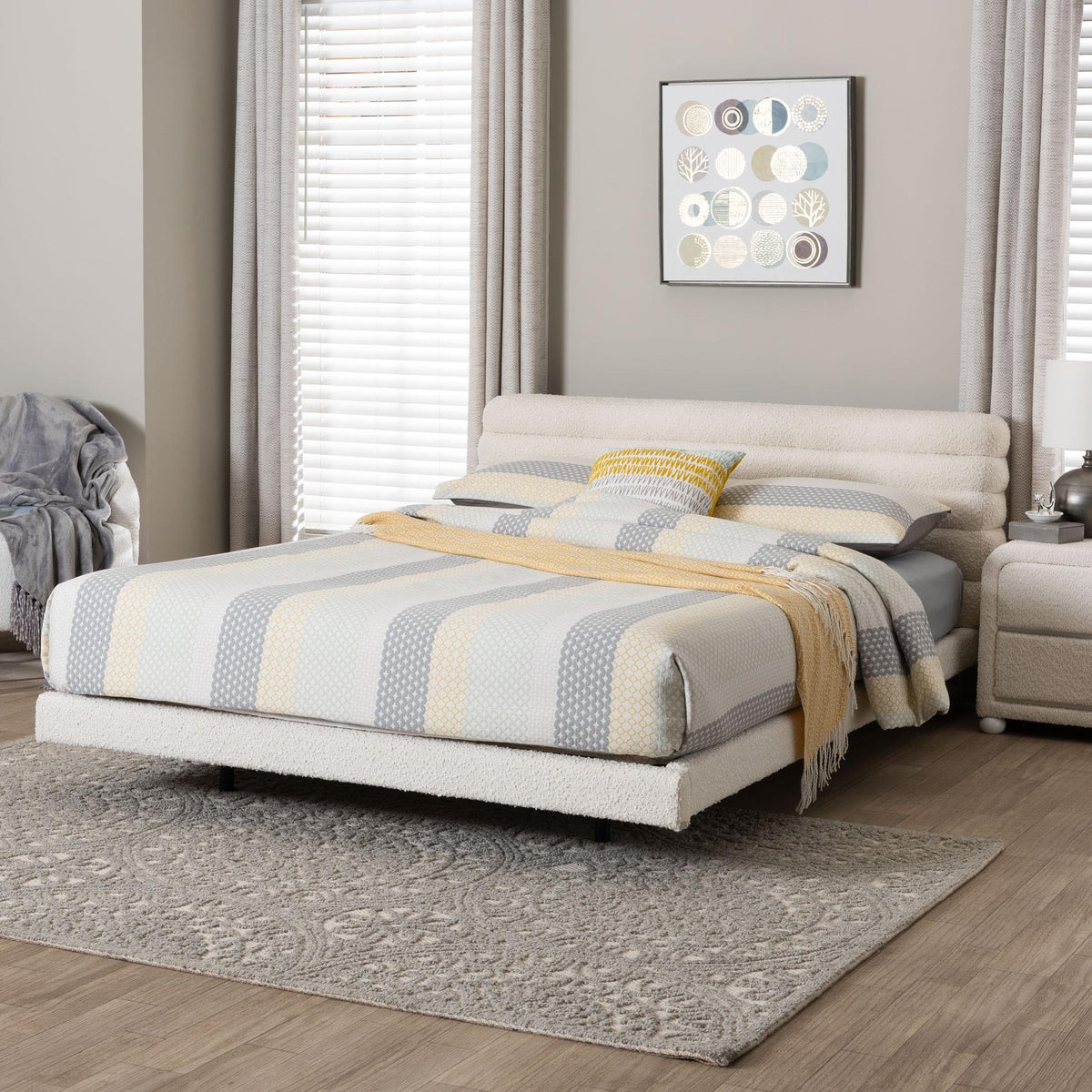
Of the five beds in this guide, only the Alfie is sold as a floating bed: its listing gives "inset legs" as what creates its floating base design. The Tarian listing says its clear acrylic legs "make the bed look like it's floating," which describes an effect, not how the bed is sold.
How does a floating bed stay up?
A floating bed stays up the way any bed does: its weight goes down to the floor, or into the wall. The supports are just hidden or see-through. Saatva's guide describes four ways to do it:
- Center-set legs: legs placed closer to the center of the frame. The Alfie's inset legs fit this method.
- Hidden base: a single smaller box platform underneath, placed so it isn't visible from the outside.
- Clear legs: lucite (clear acrylic) legs located further from the corners and closer to the center. The Tarian also uses clear acrylic legs; its listing doesn't say where they sit.
- Wall mount: the bed is wall-mounted and held up with a single support leg.
LAGO's Fluttua shows the wall-anchored approach: one central, height-adjustable support anchored to the wall, which LAGO says was tested to support a maximum load of 240 kg (about 529 lb), a figure for LAGO's bed only. DIY floating bed builds exist too, but they're outside this guide.
What is a low-profile bed frame?
A low-profile bed frame keeps the mattress close to the floor. The label describes height, not how the bed is supported.
The Luma, Granger and Raewyn are all sold as platform beds. Sleep Foundation describes a platform bed as a thin slatted or solid base mounted on four or more legs that supports the mattress with no need for an additional bed frame or box spring.
What we found across our own listings: "low profile" covers quite different heights, so read the numbers. To the top of the slats, the Alfie lists 9.6", the Granger 10.2" and the Raewyn 13". Under-bed clearance is 5.5" on the Alfie and 9.6" on the Raewyn, and the Granger has a covered baseboard, with its base listed at 2.8" high. The Luma's listing describes a "floor-hugging profile" but gives no measurements.
Those inches matter, because a frame's height can affect how easy it is to get into or out of bed. As a rough figure, the 8" recommended mattress thickness on the Alfie listing would put the top of the mattress about 17.6" off the floor.
Floating vs. low-profile: what's the difference?
Floating is about hidden or inset supports, while low profile is about height. A floating bed tends to be low, Saatva says, but plenty of low beds aren't floating: of the five beds below, only the Alfie is sold as one.
Five beds, as listed
| Bed | Sold as | How it meets the floor (listing's words) | Top of slats (as listed) | Under-bed clearance or base (as listed) | Overall size (as listed) |
|---|---|---|---|---|---|
| Alfie, king | Floating bed; low profile | Inset legs | 9.6" | 5.5" clearance | 80.1" W x 91.7" D x 32.1" H |
| Tarian, queen | Storage bed with LED; legs "make the bed look like it's floating" | Clear acrylic legs | Not listed | Not listed | 64" W x 90" D x 68" H |
| Luma, king | Upholstered platform bed | "Floor-hugging profile" | Not listed | Not listed | Not listed |
| Granger, queen | Low profile | Covered baseboard | 10.2" | Base 2.8" high | 66.5" W x 87.8" D x 40.7" H |
| Raewyn, queen | Low profile | Straight legs | 13" | 9.6" clearance | 63.4" W x 85.4" D x 47.2" H |
The Alfie boucle floating bed listing describes a low-profile style "with low clearance" and gives boucle upholstery over foam and a channel-tufted headboard with horizontal channels.
The Tarian queen bed with clear acrylic legs is a storage bed: the listing gives two deep storage drawers in the footboard, hidden LED lighting and boucle padding in the headboard, and mirrored trim.
The Luma chenille king platform bed listing describes a tall, padded headboard with bumper-style padded sides and foot, all wrapped in chenille to form one continuous frame around the mattress. It gives no measurements.
The Granger velvet low-profile bed is listed as mid-century modern inspired, with velvet upholstery, a channel-tufted headboard, wide padded railings and a covered baseboard. If you like the padded look of the Alfie, Luma and Granger, our upholstered beds collection has more.
The Raewyn rattan platform bed listing gives a rounded headboard with a woven synthetic rattan inlay, straight legs and a rubberwood frame.
What are the downsides of a floating bed?
The main downsides of a floating bed are a low height that some people find hard to get out of, limited storage when the clearance is small, harder moves for wall-mounted versions, and weight limits that vary by frame.
Saatva notes that the low-profile design may make it difficult for some people to get in and out of bed, and that floating beds may not suit older adults or people with specific mobility conditions.
Saatva lists the space underneath as usable for storage, while Sleep Foundation, reviewing one frame with roughly 6 inches of under-bed clearance, suggests another frame if you want extra storage space. The Alfie listing gives 5.5" of clearance.
Moving a floating bed can be a hassle, Saatva says, especially a wall-mounted one. The Fluttua, for one, is anchored to the wall.
The same guide adds that some floating frames come with weight restrictions and that the quality of the frame affects how well it holds up, so we'd check the weight limit on the specific listing before you buy.
On the plus side, Saatva says it's easier to clean underneath a floating bed, because the legs don't get in the way.
Who should skip a floating or very low bed?
A floating or very low bed is worth skipping, in our view, if getting up from a low seat is hard for you, if you need real under-bed storage, or if you move often and were looking at a wall-mounted design.
If getting in and out of a low bed is hard for you, look for a higher top-of-slat number, given the mobility concerns Saatva raises. The Raewyn's 13" slats are the tallest listed here.
If you need storage, the Tarian puts it in two footboard drawers.
In our view, a wall-mounted floating bed suits owners who won't move it. For a floating bed, Saatva suggests nightstands the same height as the bed.
Frequently asked questions
How strong is a floating bed?
A floating bed's strength depends on the frame. Saatva notes that some floating frames come with weight restrictions and that frame quality matters. LAGO says its own Fluttua was tested to a maximum load of 240 kg (about 529 lb). Check the weight limit on the specific listing before you buy.
Do floating and low-profile beds need a box spring?
Floating beds, like platform beds, don't require a box spring, Saatva says, and Sleep Foundation says platform beds generally don't, though it says to check with the manufacturer. The Alfie, Luma, Granger and Raewyn listings each say their slats remove the need for one. Our guide to whether you need a box spring with a platform bed goes deeper.
Can you put storage under a floating bed?
Sometimes. Saatva lists under-bed storage as a pro, but Sleep Foundation, reviewing one frame with roughly 6 inches of clearance, suggests another frame if you want extra storage space. The Alfie listing gives 5.5 inches of clearance. Measure your bins against the clearance on the listing before you buy.
Do floating beds have lights?
Some do. Saatva says some floating frames come with below-bed platform lights, and LAGO says LED lighting can be built into the lower part of the Fluttua base and the headboard. Among our beds, the Tarian listing has hidden LED lighting in its headboard; the Alfie, Luma, Granger and Raewyn listings mention no lights.
Are floating bed frames good?
They suit a modern, minimalist room, which Saatva says floating beds fit well, and they're easier to clean under. The trade-offs are a low height, limited storage when clearance is small, weight limits that vary and harder moves for wall-mounted versions.
Is a low-profile bed the same as a platform bed?
Not exactly. A platform bed is a slatted or solid base on legs that supports the mattress without a box spring, Sleep Foundation explains. In our view, a platform bed can be low or tall, and low profile only describes height. The Raewyn is both: a platform bed sold as low profile.
Should you get a floating or low-profile bed frame?
The right choice depends on which matters more to you: the hidden-support look or the height. For the look, the Alfie is the one bed here sold as floating; for easier reach, start near the Raewyn's 13" slats. Then check the listed slat height and clearance against your mattress thickness and how easily you get up.