
 Browse Our Wide Selection of Beds, Chairs & More


By Yeti Beds Team, updated November 2026
A four-poster bed is a bed with a vertical post at each corner, and those posts support a tester, an overhead panel, or simply end in bedknobs. A canopy bed is a bed with a canopy, usually hung with bed curtains. So a canopy bed usually starts as a four-poster, but a four-poster doesn't need one.
This guide is about fit before looks. The same label covers frames from 59.1" to 86.5" tall in our own catalog, so we give real heights from five listings, do the ceiling subtraction, cover queen clearance and list the plain downsides. If you already know you want fabric overhead, start with our canopy beds.
What is a four-poster bed?
A four-poster is a bed frame with a tall post, or bedpost, at each corner. Wikipedia also calls it a tester bed; the tester is the panel the posts can support overhead.
You'll also see "poster bed" used as a shorter name for the same frame. Posts vary a lot. Our listings describe turned bobbin posts, ring-turned posts and sculpted spindle posts, plus a fluted headboard and footboard on one canopy frame. Some post tops carry finials, decorative end caps that hold a canopy in place.
Four-poster vs. canopy bed: what's the difference?
A canopy bed differs from a four-poster by its roof: it has a framed rooflike structure suspended over a bed, usually with curtains, while a four-poster only needs its four posts.
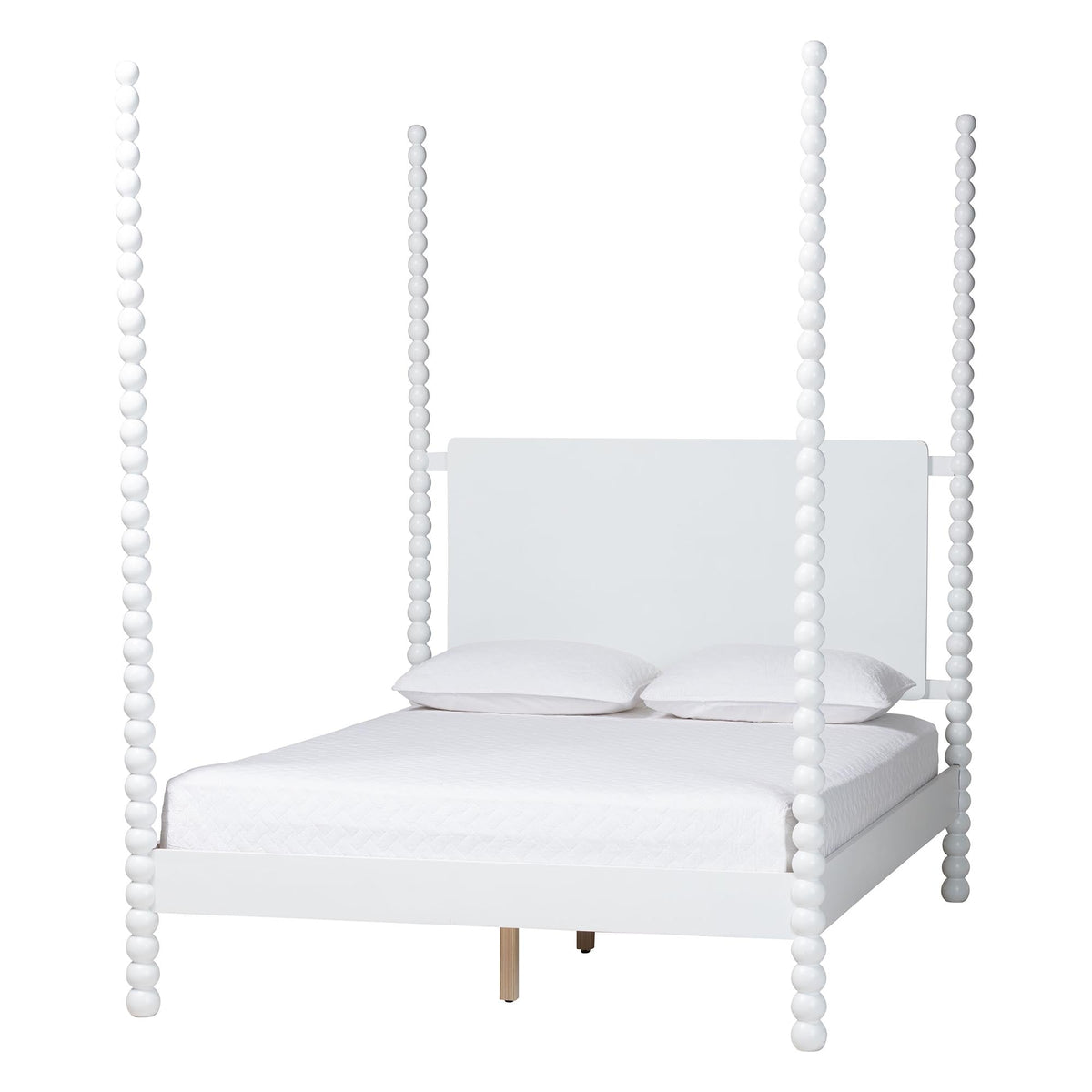
Wikipedia splits modern canopy beds into traditional and contemporary designs, with contemporary frames in wood, metal or both. In our catalog, the Cherene four-poster in white has turned bobbin posts at each corner and a "canopy-like" upward look, but it has no canopy frame, so it's a four-poster, not a canopy bed. The Primrose king canopy bed is listed in rubberwood and engineered wood. The Alva wood canopy bed in oak is described as a "4-post wood canopy platform bed frame" with an "open-frame canopy design".
| Feature | Four-poster | Canopy bed |
|---|---|---|
| Defining part | A post at each corner | A canopy over the bed |
| Overhead frame | Optional (tester) | Yes, often curtained |
| Our examples | Cherene, Martino, Caliana, Aleda | Primrose, Alva |
Why were four-posters and canopies made?
Four-posters were built partly for warmth and privacy. Bedrooms were often drafty and cold at night, so curtains kept sleepers warm, and they gave privacy when servants and bodyguards often slept in the same room. Antique examples survive from the 16th century and earlier, many in oak.
The canopy did similar work: Wikipedia says the canopy and curtains keep the bed warmer and screen it from light and sight. For scale, the Great Bed of Ware is a four-poster constructed around 1590 and listed at 267 cm high, 326 cm wide and 338 cm deep, about 105 inches tall.
How tall is a four-poster bed?
Four-posters have no standard height. Our five listings with dimensions run from 59.1" to 86.5" overall, and the Alva listing gives no measurements at all.
| Bed | Size | Overall height | Head / foot posts (from frame up) | Top of slats | Under-bed clearance |
|---|---|---|---|---|---|
| Cherene | Queen | 86.5" | Not listed | 12.4" | 9.6" |
| Primrose | King | 83.5" | Not listed | Not listed | Not listed |
| Martino | Queen | 70.9" | 54.5" / 23" | 13" | 7.4" |
| Aleda | Queen | 66.8" | Not listed | 12.4" | 5.8" |
| Caliana | Queen | 59.1" | 36.5" / 17.8" | 13.7" | 10.2" |
The post columns hold a surprise. The Martino platform bed listing gives headboard posts of 54.5" and footboard posts of 23", and the Caliana bobbin bed listing gives 36.5" and 17.8". So, from these two listings, "four-poster" doesn't promise four equal posts, and the post lengths tell you more than the name.
What ceiling height do you need for a four-poster bed?
Your ceiling has to clear the frame's overall height with room to spare. Measure it at the spot where the bed will go, not in the middle of the room.
The 2021 International Residential Code, section R305.1, says habitable spaces shall have a ceiling height of "not less than 7 feet", which is 84 inches, with an exception for sloped ceilings. That is a minimum, not a typical height.
Here is the simple subtraction for our two tallest frames:
- Cherene, 86.5": 2.5" taller than the 84" minimum, so it won't stand in a room built to the bare minimum. Under an 8-foot (96") ceiling it leaves 9.5".
- Primrose, 83.5": under a 96" ceiling it leaves 12.5".
In our view, that leftover space has to cover more than air. Leave room for finials, light fixtures and ceiling fans, and for the height you need to tip the frame upright during assembly.
How much room does a four-poster need?
A queen four-poster needs at least 30 inches of clear floor on each open side, or 36 inches for comfort. Dimensions.com gives minimum clearances of 30" and comfortable clearances of 36" around a queen bed, and a minimum room area of roughly 106 sq ft for a queen with clearance.
The frame itself is only part of that. Width times depth from each listing puts the Cherene at about 38.7 sq ft of floor and the Caliana at about 36.5 sq ft. In our view, the foot posts matter more than the footprint in a tight room, because they sit right where you walk. For the same reason, a queen four-poster bed with 17.8" footboard posts, like the Caliana, is easier to walk past than one with full-height foot posts. For mattress and frame sizes, see our guide to queen bed dimensions.
Which four-poster style suits your room?
The right four-poster style depends on post height first and headboard second. The style notes below are our opinions; the details come from each listing.
- Tall bobbin posts: the Cherene, a white four-poster with a smooth panel headboard and a rubberwood and MDF frame. Good for a tall room where you want height without fabric.
- Short or mixed posts: the Caliana (turned bobbin posts, cutout headboard, mid-century inspired) and the Martino (sculpted turned spindle posts, cutout headboard). Both read as vintage-inspired and lighter on the eye.
- Upholstered headboard: the Aleda in beech brown, with ring-turned posts, a fabric-upholstered headboard and raised paneling on the sides, in a farmhouse style on a rubberwood and MDF frame.
- A canopy bed frame you can drape: the Alva, which the listing says can be styled minimally or draped with curtains, and the Primrose, with a fluted headboard and footboard, tapered legs and an ivory finish.
On drapes, our view is that sheer panels keep a canopy light, while heavier bed curtains close it in. Measure the canopy rail before you buy fabric.
What are the downsides of a four-poster or canopy bed?
The main downsides of a four-poster or canopy bed are the ceiling height it needs and the floor it takes up. In our view, these are the ones worth weighing:
- Ceiling height: our tallest frame is taller than the 7-foot code minimum.
- Visual weight: four posts, and a canopy frame on top, fill a small room fast.
- More parts to assemble: four posts and, on canopy frames, the top rails add pieces a plain frame doesn't have.
- Fabric upkeep: drapes are one more thing to wash.
- Harder to move: more pieces to take apart and carry.
- Foot posts in the walkway: a post at each foot corner is easy to clip in the dark.
Who should skip a four-poster bed?
A four-poster is a poor fit for a low or sloped ceiling, a tight room, or a household that moves often.
Under the IRC exception, part of a sloped room can sit below 7 feet: the ceiling must be not less than 5 feet over the required floor area, with at least 50% at 7 feet. So check the height at the exact spot under the slope where the posts will stand. If your room can't keep 30 inches clear around a queen, look at our small bedroom layout ideas first. In our view, frequent movers will also tire of taking the extra posts apart each time.
If you still want posts, the shorter-post Caliana at 59.1" overall is the gentler option. If you don't, a plain platform bed with wood slats gives you a bed with nothing at the corners.
Four-poster and canopy bed FAQ
What are the parts of a canopy bed called?
A canopy bed's main parts are the bedposts (head posts and foot posts), side rails, headboard, footboard, the canopy, the crown at the apex of a raised canopy, and finials, decorative end caps for the bed posts that hold a canopy in place.
What is the thing above a bed called?
The structure above a bed is called a tester or a canopy. The tester is the upper, usually rectangular panel that the posts support, and it often has rails for curtains.
Do four-poster beds need a box spring?
The six frames in this guide don't: each listing says its wood slats remove the need for a box spring. The Cherene and Aleda listings give slats 3.5" apart, the Martino and Caliana listings give 3.2", and those two also give a recommended mattress thickness of 8 to 10 inches.
Can you hang curtains on a four-poster bed?
In our view, curtains hang most easily on a frame with a tester or canopy rail. The tester often has rails so curtains can be pulled around the bed, and the Alva listing says that frame can be styled minimally or draped with curtains.
Is a four-poster bed good for a small room?
A four-poster can suit a small room if the posts are short and you keep at least 30 inches clear around a queen. In our view, tall posts and heavy drapes make a tight room feel smaller, so a short-post frame like the Caliana is the easier fit.
So which frame fits your ceiling?
Your ceiling height should pick the frame. Under 8 feet, start with a shorter-post frame such as the Caliana at 59.1" overall. At 8 feet or more, the Cherene fits with 9.5" to spare, and if you want fabric overhead, the Primrose leaves 12.5" under a 96" ceiling. Measure first, then browse our canopy beds collection.