
 Browse Our Wide Selection of Beds, Chairs & More


By Yeti Beds Team, updated November 2026
A mid-century modern bedroom takes its cues from design made from about 1933 to 1965, with clean lines and organic shapes. In practice that means warm natural wood tones, low-profile shapes and a low platform bed, usually raised on tapered or splayed legs. For 2026, the designers The Spruce asked favor earthier colors, more texture and less matching.
Below: four real beds that fit, nine styling ideas and an honest trend check. To shop, start with our platform beds.
What is mid-century modern design?
Mid-century modern is a design style known for clean lines, organic shapes and function, made from about 1933 to 1965. Merriam-Webster places it in roughly the 1930s through the mid-1960s, adds "lack of embellishment" to its definition and dates the term's first known use to 1953.
Cara Greenberg has said her 1984 book Mid-Century Modern: Furniture of the 1950s popularized the term. Sources draw the dates differently: Dezeen notes it may once have meant furniture made between 1947 and 1957, while The Guardian gives the 1940s to the 1970s.
In the US, designers took up postwar materials such as molded plywood and fiberglass, while Scandinavian designers handcrafted in wood and leather.
Britannica notes that many new pieces sold as mid-century modern are "inspired by" the style. So are the beds in this post: new designs inspired by mid-century modern (MCM), not period pieces or reissues.
What makes a bedroom look mid-century modern?
A bedroom looks mid-century modern when it combines warm natural wood, clean lines, low-profile and organic shapes, and muted colors with pops of bold shades, with furniture raised on tapered or flared legs.
BHG's examples include wooden nightstands with tapered legs, a low platform bed between flared-leg nightstands, black swing-arm sconces, brass wall sconces and geometric, space-age lighting. It also counts built-ins among the style's markers.
Mark Hampshire of Mini Moderns, quoted in The Guardian, noted that a classic mid-century sofa stands on legs that leave the floor visible, which he says makes a room feel larger. He meant sofas. In our view, a bed on legs works the same way. If space is tight, see our small bedroom ideas.
What kind of bed is mid-century modern?
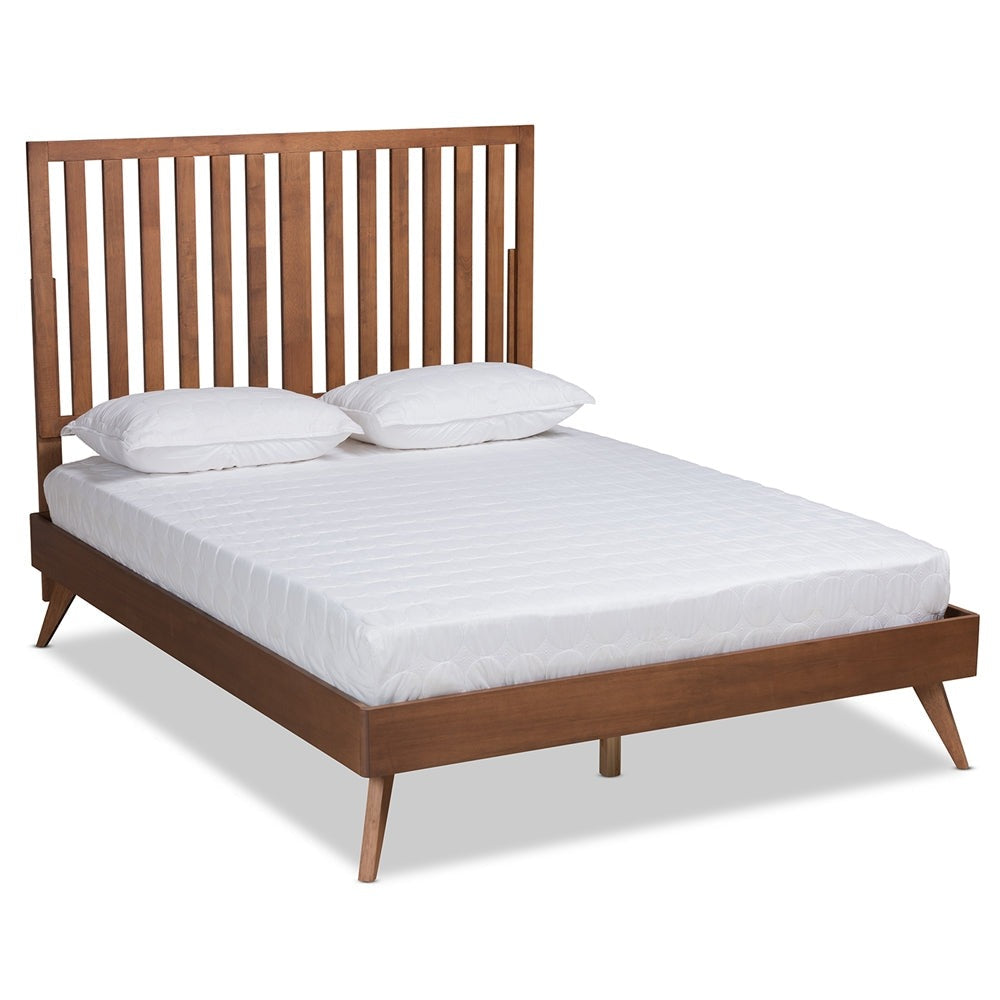
A mid-century modern platform bed, in our view, is low, wood-toned and raised on tapered, angled or splayed legs, with a simple slatted, cane or upholstered headboard. That view rests on the low platform bed and tapered-leg furniture in BHG's examples and on one bed from 1954.
Herman Miller's Nelson Thin Edge Bed dates from 1954. Today's version "now features slats instead of springs to accommodate memory foam mattresses," the headboard comes with or without woven cane, and the legs may be wood or stainless steel. In our view, slats, woven cane and visible legs are the details to look for in any bed inspired by it.
Four mid-century-style beds, as listed
| Bed | Legs (listing's words) | Headboard | Finish / materials | Overall size (as listed) | Height detail (as listed) |
|---|---|---|---|---|---|
| Margo walnut queen | Splayed rubberwood legs | Frame only; compatible with Robbie, Draper, Archie and Collins headboards | Walnut; wood, MDF and veneer | 82.5" L x 63.5" W x 15" H | Legs 11" |
| Saki walnut queen | Angled | Slatted wood, 5 height settings | Walnut brown; rubberwood and engineered wood | 58.1" H x 63.8" W x 83.4" D | Top of slat 11.8" |
| Rina queen | Angled, tapered | Wrap-around, woven synthetic rattan panels | Ash walnut; rubberwood, MDF ash veneer, LVL | 37.4" H x 63.78" W x 83.31" D | Legs 10" |
| Helsa queen | Tapered | Padded, channel-tufted grey fabric | Walnut brown; rubberwood and MDF | 38.4" H x 65.7" W x 86.5" D | Top of slat 12.2" |
For the Margo walnut queen platform bed, the listing gives four splayed rubberwood legs, a wood slat system, a reinforced center beam and an overall height of 15 inches, the lowest of the four. It calls the frame compatible with the Robbie, Draper, Archie and Collins headboard collections. We'd choose it where a tall headboard would crowd a window.
For the Saki walnut queen platform bed, the listing gives angled legs, an overall height of 58.1 inches and a slatted wood headboard with five height settings.
The Rina rattan queen platform bed sits on angled, tapered legs, and the listing describes a wrap-around headboard with woven synthetic rattan panels in an ash walnut finish. In our view, it is the closest of the four to the Nelson bed's optional woven cane headboard panel, since its own headboard uses woven synthetic rattan.
The Helsa channel-tufted queen bed is the soft option. The listing gives a padded headboard wrapped in smooth grey fabric with channel tufting, tapered legs and a walnut brown finish.
All four listings say their slats remove the need for a box spring. Check the overall footprint, not just the mattress size: by the listed outer dimensions, the Helsa covers about 39.5 sq ft, the largest of the four, against about 36.4 sq ft for the Margo. Still weighing frame materials? Read our take on metal vs. wood bed frames.
How do you style a mid-century modern bedroom in 2026?
These mid-century modern bedroom ideas start with warm wood and clean lines, then add earthy color, texture and a mix of old and new pieces.
- Pick a palette. BHG pairs white with warm wood for an airy room, muted peach, brown or orange for a cozy one, and deep blue with emerald green and rich wood for a moody one. Designer Lauren Saab of Saab Studios told The Spruce to keep the classic bright hues to small doses.
- Let the bed's wood lead. Repeat it in a low walnut nightstand, which BHG uses to show natural materials as a hallmark of the style.
- Light from the wall. In one BHG room, black swing-arm sconces offer symmetry; brass wall sconces and geometric, space-age fixtures also appear in BHG's rooms.
- Layer the rug. Start with a sisal or jute base and top it with a patterned rug. Mixed patterns should share at least one color, per BHG.
- Add texture. Saab, speaking to The Spruce, says the clean lines are now mixed with stone, velvet, cane and handmade finishes; the same piece adds that velvet and boucle bring warmth.
- Consider wood paneling or built-ins. BHG shows a wood-paneled wall with a built-in bed, wardrobe and nightstands as a focal point typical of 1950s design.
- Soften with natural pieces. Wicker baskets or a woven bench break up the starkness, and potted plants add life and texture, per BHG.
- Mix, don't match. The Spruce says matching furniture sets are no longer en vogue, and interior designer Carina Harford told The Guardian that the rush to buy full sets of mid-century tables, sofas and lighting is over.
- Skip the clichés. Saab told The Spruce that hairpin legs and orange pillows are overdone and now come across more like props than design.
Is mid-century modern still popular in 2026?
Mid-century modern is still popular in 2026, with caveats. The designers The Spruce asked in September 2026 said it isn't going out of style, though the Mad Men-style 1960s take now feels dated, and US searches for the look have cooled from their 2020-2022 peak.
Asked whether it will be out of style, Nureed Saeed, owner and creative director of Nu Interiors, gave The Spruce one word: "never." Greenberg told Dezeen in 2024 that it is "never going away."
Laura Budds, a vintage furniture dealer in Norfolk in the UK, sees it differently. She told The Guardian in October 2026: "we have reached the peak, and we're on the descent."
Our look at US Google search data shows interest cooling. Searches for "mid century modern bedroom" average about 6,600 a month and ran between 5,400 and 6,600 a month through 2026, against monthly highs of 18,100 in 2020 to 2022. The 12 months to September 2026 were about 22% lower than the 12 months before.
In our view, the look is settling into a classic you mix in, not a trend you copy wholesale.
Who should skip the mid-century look?
The mid-century look is a poor fit, in our view, if you want a fully matched, showroom-style suite, if you love maximal pattern and antiques in every corner, or if you want a deep, sink-in headboard to lean on.
The Spruce reports that designers now see overly matched furniture as showroom-like, and a designer quoted by The Guardian says the craze for buying full sets is gone. If you want something softer to sit up against, a padded, channel-tufted headboard like the Helsa keeps the look.
Frequently asked questions
What colors go in a mid-century bedroom?
Better Homes & Gardens lists crisp whites, warm muted shades and jewel tones as the core palette, with muted colors broken up by pops of bold shades. The Spruce suggests burnt orange, olive green, dark brown and smoky blue, with bright colors used in small doses.
What are some famous mid-century furniture brands?
Herman Miller and Knoll, two manufacturers of iconic mid-century designs, both began selling directly to consumers and reissuing pieces in the 1990s. Designers to know include Charles and Ray Eames; George Nelson, Design Director at Herman Miller for over 25 years; and Eero Saarinen, whose Tulip chair was made for Knoll.
Is a platform bed mid-century modern?
A platform bed can be, but the frame type alone doesn't make it so. BHG features a low platform bed in its midcentury examples, and the 1954 Nelson Thin Edge Bed now uses slats instead of springs. In our view, a warm wood tone and visible legs make a platform bed read as mid-century.
Do mid-century platform beds need a box spring?
The four beds in this post do not, according to their listings: the Margo, Saki, Rina and Helsa each use slats, and each listing says that removes the need for a box spring. For any other frame, check its own listing.
Our recommendation
Start with one wood-toned bed on visible legs, measure its overall footprint against the room, then build the palette and texture around it. We'd start with the frame-only Margo if a window sits behind the bed; if you want a woven headboard like the cane option on the 1954 Nelson bed, we'd pick the Rina. Browse all platform beds, or narrow it to wood platform beds.