
 Browse Our Wide Selection of Beds, Chairs & More


By Yeti Beds Team, updated November 2026
The metal vs. wood bed frame choice comes down to weight, noise and look more than lifespan. Casper puts average lifespans at 7 to 10 years for wood and about 15 for metal, but calls them "averages, not rules": build quality can matter more. Metal frames are usually lighter, and wood frames need their joints kept tight.
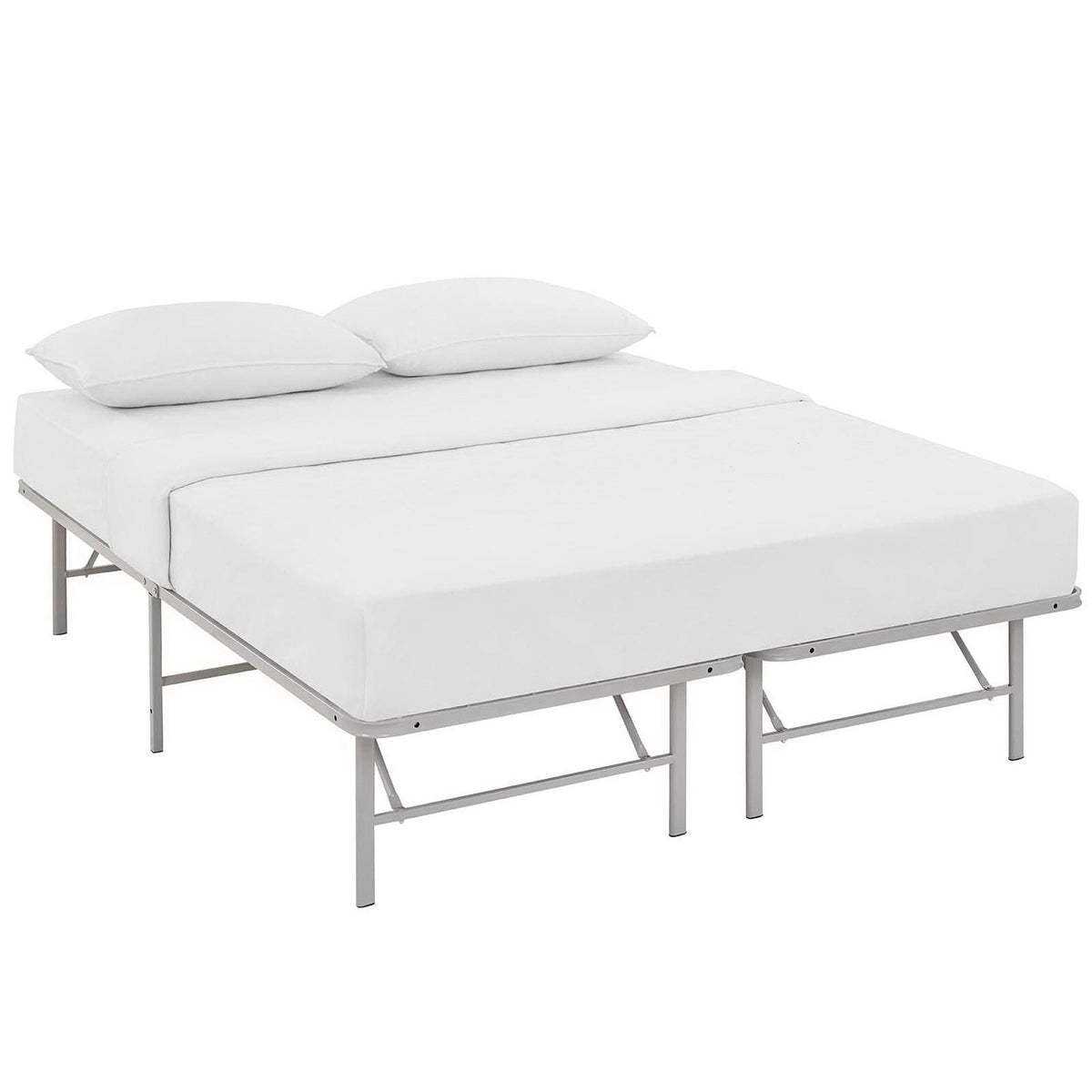
Among our metal bed frames, the Horizon stainless steel queen frame weighs 39 lb, according to its listing. The listings for the Karine queen platform bed and the Haines queen platform bed each give 92.6 lb, about 2.4 times as much (53.6 lb more). Both are wood platform beds made of rubberwood plus engineered wood (MDF, and LVL in Karine), not solid wood throughout.
Metal vs. wood bed frame: which is better?
Neither a metal nor a wood bed frame is better on every count. Sleep Foundation says frames of any material may be durable and high quality, and that the most notable difference between materials is usually appearance.
Our view on the metal bed frame vs. wood decision: metal suits renters, frequent movers and guest rooms, given the lower listed weights and Horizon's fold-away design. Wood suits a long-term main bedroom where you want a headboard and a warmer look.
Four frames from our catalog, by the numbers
| Frame | Material (as listed) | Overall size (W x D x H) | Weight | Height detail | Box spring |
|---|---|---|---|---|---|
| Horizon queen | Stainless steel | 60 x 80 x 14 in | 39 lb | 14 in of space underneath; folds away | Not needed |
| Alina queen | Powder-coated steel | 62.5 x 84 x 34.5 in | 34 lb | 12.5 in to top of frame | Not needed |
| Karine queen | Rubberwood, MDF ash veneer, LVL | 67.6 x 86.5 x 39.4 in | 92.6 lb | Legs 8.7 in; slat top 11.8 in | Not needed |
| Haines queen | Rubberwood/MDF | 64.3 x 86.1 x 32.4 in | 92.6 lb | Legs 3.4 in; slat top 6.1 in | Not needed |
Wood vs. metal bed frame at a glance
| Factor | Metal | Wood | Source |
|---|---|---|---|
| Typical lifespan | About 15 years, sometimes longer | 7 to 10 years | Casper, Saatva (averages, not rules) |
| Noise | Squeaks when bolts loosen or parts grind | Creaks when joints weaken; FlexiSpot says often quieter | Casper, FlexiSpot |
| Moisture | Does not warp, per FlexiSpot | Swells and shrinks with moisture; can warp, check or split | FlexiSpot, USDA |
| Weight (our listings) | 34 lb (Alina), 39 lb (Horizon) | 92.6 lb (Karine, Haines) | Product listings |
| Price tendency | Typically less | Typically more | Sleep Foundation |
| Bed bugs | Can hide in frame cracks and screw heads | Same | EPA |
| Biggest difference | Appearance | Appearance | Sleep Foundation |
How long does a metal bed frame last?
A metal bed frame often lasts up to 15 years, and sometimes longer, according to Casper. Saatva says metal frames may last 15 years or longer, against seven to 10 years for slatted wood frames that are properly maintained. Casper stresses that these are averages, not rules.
Sleep Foundation says a lower-quality frame could develop breaking wood, bending metal or creaking within a few years, and that high-quality bed frames sometimes last for decades. Casper treats noise that comes back within weeks of tightening everything as an early warning sign that the frame's integrity is declining. On wood frames, Saatva says slats are usually the first thing to go.
Do metal bed frames squeak more than wood ones?
Both metal and wood bed frames can squeak or creak. FlexiSpot, a furniture brand, writes that wood frames are often quieter than metal, but that is one brand's view.
Casper gives each material its own cause: metal frames squeak when bolts loosen or parts warp or grind, while wood frames creak when joint connections start weakening.
For metal bed frame squeaking, or any squeaky bed frame, Sleep Foundation lists these fixes:
- Tighten all joints with a wrench or screwdriver.
- Add plastic washers to avoid metal-on-metal contact.
- On metal frames, lubricate the joints with a product like WD-40.
- If the mattress rubs the frame, line the frame with thin fabric or felt.
- Add furniture pads to the legs and level the bed.
- On wood-on-wood contact points, apply a thin layer of beeswax or candle wax.
Follow your frame's own assembly instructions when you retighten anything. The Horizon listing says its design "reduces annoying squeaks and unpleasant bending or buckling." That is listing copy, not a test result.
Which is more durable, a metal or a wood bed frame?
Build quality can matter more than the material in how durable a metal or wood bed frame is, by the accounts of Casper and Sleep Foundation. In our view, you find the sturdiest bed frame by checking center support, slat details and hardware first.
The USDA Forest Products Laboratory's Wood Handbook says wood swells as it gains moisture and shrinks as it loses it, which can cause warping, checking and splitting. FlexiSpot writes that metal does not warp, but that metal frames can scratch floors or chip paint when shifted.
Our wood frames are not solid wood throughout: the Karine listing gives rubberwood with MDF ash veneer and LVL, and the Haines listing gives rubberwood/MDF. The Horizon listing gives a weight capacity of up to 1,300 lb, and the Alina listing gives a maximum of 1,323 lb with a reinforced center beam.
Can you put a mattress directly on a metal bed frame?
You can put a mattress directly on a metal platform bed frame such as Horizon, whose listing says it eliminates the need for a box spring. A standard metal rail frame is different: Saatva says you need a foundation with one, or your mattress won't have adequate support.
Each wood platform bed frame here also goes without one: the Karine listing says its slats eliminate the need for a box spring, and the Haines listing lists wood slats, no box spring and 3.5 in between slats. Check your mattress maker's slat-spacing and foundation rules before you buy, and read our guide on do you need a box spring.
Do bed bugs live in metal or wood bed frames?
Bed bugs can hide in metal and wood bed frames alike. The EPA says they can be found in cracks on the bed frame and headboard, and "even in the head of a screw." No frame material is bed-bug-proof; see the EPA's guide for inspection.
Which style suits your room: metal or wood?
Appearance is usually the biggest difference between metal and wood bed frames, according to Sleep Foundation. Four looks from our catalog:
- Horizon: a low-profile stainless steel base that "easily folds away when not in use," per its listing, with "a generous 14 inches of space underneath." Its 60 x 80 in footprint matches a queen mattress (60 x 80 in), about 33.3 sq ft.
- Alina metal platform bed: powder-coated steel with a headboard and footboard, which its listing calls a "Rustic Cottage Metal Platform Bed." At 62.5 x 84 in, it covers about 36.5 sq ft.
- Karine: angled 8.7 in legs and a headboard on two narrow support bars for what the listing calls "a cool, floating effect." It covers about 40.6 sq ft, about 7.3 sq ft more than Horizon.
- Haines: a walnut brown, low-profile platform with a 6.1 in slat top. It covers about 38.4 sq ft.
Measure your room and mattress before buying. Our queen bed dimensions guide helps with the mattress side.
Who should NOT choose metal, and who should NOT choose wood?
Skip metal if, in our view, you want a warm-looking wood headboard as the room's focal piece.
Skip wood if you move often or will carry the frame up stairs alone. The Karine and Haines listings give 92.6 lb each, against 39 lb for Horizon. Think twice about wood in a damp room where moisture swings are likely, too: the Wood Handbook links shrinking and swelling to warping, checking and splitting.
Skip both if you won't check hardware. Casper says to tighten hardware every few months, since bolts and screws naturally loosen over time, especially in wood frames.
Frequently asked questions
Are metal bed frames better than wood?
Metal bed frames are not better than wood across the board. Sleep Foundation says frames of any material may be durable and high quality, and that wood frames typically cost more. The Horizon and Alina listings give 39 lb and 34 lb, against 92.6 lb each for Karine and Haines.
How long does a wood bed frame last?
A wood bed frame lasts 7 to 10 years on average, according to Casper, and Saatva gives seven to 10 years for slatted wood frames that are properly maintained. Casper calls these averages, not rules. Saatva adds that slats are usually the first thing to go.
Why does my metal bed frame squeak?
A metal bed frame squeaks when bolts loosen or parts warp or grind, per Casper. Sleep Foundation suggests tightening all joints, adding plastic washers and lubricating metal joints with a product like WD-40. If noise comes back within weeks of tightening, Casper calls that an early warning sign.
Is rubberwood good for a bed frame?
A rubberwood bed frame responds to moisture like any wood frame. The USDA Wood Handbook says wood swells and shrinks as moisture changes, and lists rubberwood shrinkage from green to oven-dry as 2.3% radial, 5.1% tangential and 7.4% volumetric. Those are lab figures, not bedroom predictions. Karine and Haines pair rubberwood with MDF.
Do metal bed frames need a box spring?
A metal platform frame does not need a box spring, but a standard metal rail frame needs a foundation, per Saatva. The Horizon listing says it eliminates the need for a box spring, and the Alina listing says no box spring is needed. Check your mattress maker's foundation rules too.
Should you buy a metal or wood bed frame?
Our pick: buy a metal bed frame if you rent, move often or are furnishing a guest room, and a wood platform bed for a long-term main bedroom where you want a headboard and a warmer finish. Browse our metal bed frames and wood platform beds, and check the bolts every few months either way, as Casper says to.